

Built in 1920, Taipei city has since grown to a huge area of 272 sq km with a population of 26.3 million. In its process of evolution, Taipei has retained much of the city management and traffic system from its Japanese colonial days and also incorporated a systematic approach as in most international cities.
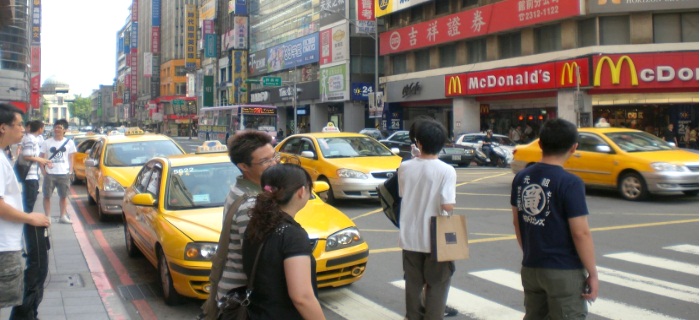
Whenever I’m in Taipei, I’d love to hop onto the familiar yellow cab of Taipei that is spacious and clean inside out. Of particular mention is that, the taxi drivers are very professional in their service, well-mannered and pleasant. Their professionalism takes them to the extent of ensuring that you arrive at the correct destination without having to worry about being taken on a ride for the extra few triggers on the meter. As a tourist, I had the sense of security and confidence when I board the yellow cab of Taipei. This pleasant rapport isn’t merely due to our ability to communicate in the same language. It is, in fact, due to their good working attitude, cultural background and a sense of gratitude in them. The cab drivers recognize their role in meeting the needs of the society.
As I sat in the cab, I could observe the attitude and approach of the cab driver. Other than striking a conversation with “Where are you from?”; the driver would apologise and ask for your permission to take a detour should there be any road construction or closure. If he had to drop you at a location that is not the exact point of your destination, he would ask for your approval before stopping and give the exact direction like “Please take this zebra crossing to the opposite side of the road and that is your destination over there”.
Built in 1920, Taipei city has since grown to a huge area of 272 sq km with a population of 26.3 million. In its process of evolution, Taipei has retained much of the city management and traffic system from its Japanese colonial days and also incorporated a systematic approach as in most international cities. With the successful construction of Taipei 101 which boasts of a few “first-in-the-world” achievements; the world began to see Taipei in a different way.
Despite all these achievements, Taipei has not left out the importance in software enhancement to complement the hardware development in a city of remarkable stature. The attitude and professionalism of the Taipei cab drivers that we see today is a commendable effort of the Taipei authorities. In addition, the Taipei transportation system was established with the people’s needs and requirements in mind. Look around and you will notice that every station is complemented with a park of sculptures or cultural and art element. Taipei is not merely a concrete jungle; it is an advanced city filled with cultural and green elements. Not only that, free WIFI is available in most places.
Despite all these, what I treasure most in Taipei is their delectable home-cooked cuisines that are available not only at the high-end restaurants of Yangminshan but also at the nooks and alleys of Taipei city. All I have to do is flag down any yellow cab and the cab driver will be absolutely proud to recommend one of their choice locations.