



Why do you always get sick on a flight? Why do we “brace?” Why do flight attendants talk like that? We have the answers.
Why do you always get sick on a flight? Why do we “brace?” Why do flight attendants talk like that?
From the moment you enter an aircraft you are pummeled with instructions: turn your phone off, put your window blind up, put your seat upright, eat this slop.
How often do you stop to question why?
Airlines aren’t trying to make travel painful. There’s a good reason for nearly every in-flight burden. We have the answers.
 1)Why flight attendants talk like cyborgsMyth: Flight attendants are bossy robots. Fact: Flight attendants need you to listen and cooperate. Does your flight attendant remind you of “Seven of Nine” from “Star Trek — Voyager”? Flight attendants often take on the hot Borg’s direct and robotic demeanor to make passengers listen. They “will go ahead and put your seat in the up-right position” and they’re going to “need you to take your seat.” A recently published article at Forbes, written by staffer Jeff Bercovici, took an inquisitive look at the assertive vocabulary used by flight attendants. The article found that the extraneous words like “will go ahead” are linguistic techniques to catch the passenger’s attention early in a sentence so the request doesn’t have to be repeated, which is especially handy in an emergency. |
2)Why we open window blinds and put seats upright
Myth: We do this to “reset” the plane for the next round of passengers.
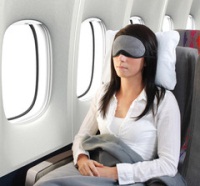
Fact: It’s a subtle safety feature. Pulling up the blinds makes us alert to potential hazards.
Elin Wong, corporate communications manager for Cathay Pacific, explains, “We ask all passengers to pull up the window shelf before landing, so that any abnormalities outside the aircraft can be duly observed by the cabin crew or passengers and be reported to the cockpit crew if necessary.”
As for that stiff 90-degree seated incline, it’s all about reducing impact. A former Air Canada flight attendant tells us that shifting those few centimeters forward reduces the distance from your head to the seat in front of you.
It also makes it easier for the passenger behind to evacuate.
3)Why airline food tastes bad
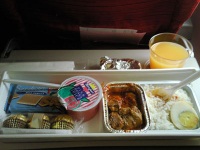
Myth: Airline food is disgusting because it’s cheap and pre-processed.
Fact: Airline food actually tastes OK; it’s the noise from the engine that distracts us.
It’s hard to comprehend at first, but the University of Manchester research article, “Effect of background noise on food perception” published by the BBC, reported that if background noise is too loud, it might draw attention away from the taste of food and towards the noise.
In the article, researcher Andy Woods fed various foods to people while they were listening to nothing or noise through headphones. He found that noisy conditions caused the subjects’ perception of saltiness and sweetness to lower, and their perception of crunchiness to increase.
So the loud and constant noise from an aircraft’s engines could have the same effect, he explains.
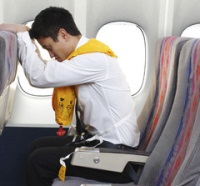
4)Why we brace during an emergency
Myth: We brace to make us feel like we have a chance of surviving; we brace to ensure we are still and calm during an emergency; we brace to preserve our dental records so coroners can identify us after a crash.
Fact: The Australian Government Civil Aviation Safety Authority clarifies, “It has been proven that passengers who assume the brace position sustain substantially less serious injuries than other passengers.”
Furthermore, the Federal Aviation Administration regulatory guideline says bracing is meant to reduce secondary impact, by positioning the body (particularly the head) against the surface it would strike during impact.
The other reason to brace is to reduce flailing around. And we all know that flailing — in any situation — will get you hurt.
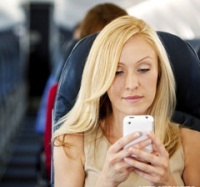 5)Why we turn off cell phonesMyth: Cell phone signals interefere with aircraft electronics. Fact: Airlines are adhering to aviation guidelines that restrict the use of personal electronic devices (PEDs), even though evidence that they interfere with aircraft systems is lacking. Airlines aren’t actually 100 percent sure that phones will interfere with aircraft systems. After all, a recent study claimed nearly 6.5 million people in 12 months left their phones on while they flew in and out of the United Kingdom without any problems. But most aviation authorities, such as the Federal Aviation Administration (FAA), prohibit the use of cell phones and other PEDs unless it can be proved they definitely do not interfere. To get approval to use a mobile, the airline would have to test every single model of phone with every single model of aircraft to make sure it doesn’t interfere with both the plane and ground networks — which would be just a little too time consuming and expensive. It’s far easier just to ask people to turn their phones off. |
Article’s source from: http://www.cnngo.com